Avocado Puree
Smooth avocado puree and pulp for guacamole, dips, spreads, sauces, dressings, prepared meals and other commercial food applications, with Hass, conventional, organic, frozen and HPP options subject to availability.
Creamy fruit solids with naturally high oil content.
Avocado (Persea americana) is botanically a fruit, although commercially it is used primarily in savory foods. Hass is the dominant commercial variety for many puree and pulp programs because of its creamy texture, rich flavor and relatively high oil content.
Unlike berries, citrus or tropical fruit purees, avocado contains very little sugar and comparatively high fat. As a result, industrial buyers focus less on Brix and more on fat or oil content, total solids, consistency, green color, oxidation control and microbiological quality.
- Commonly produced from ripe Hass avocados
- Rich, buttery texture with mild characteristic flavor
- Fat or oil content is an important purchasing specification
- Smooth, chunky and guacamole-base formats may be available
- Frozen and HPP/chilled programs are widely used
- Conventional and certified organic options may be available
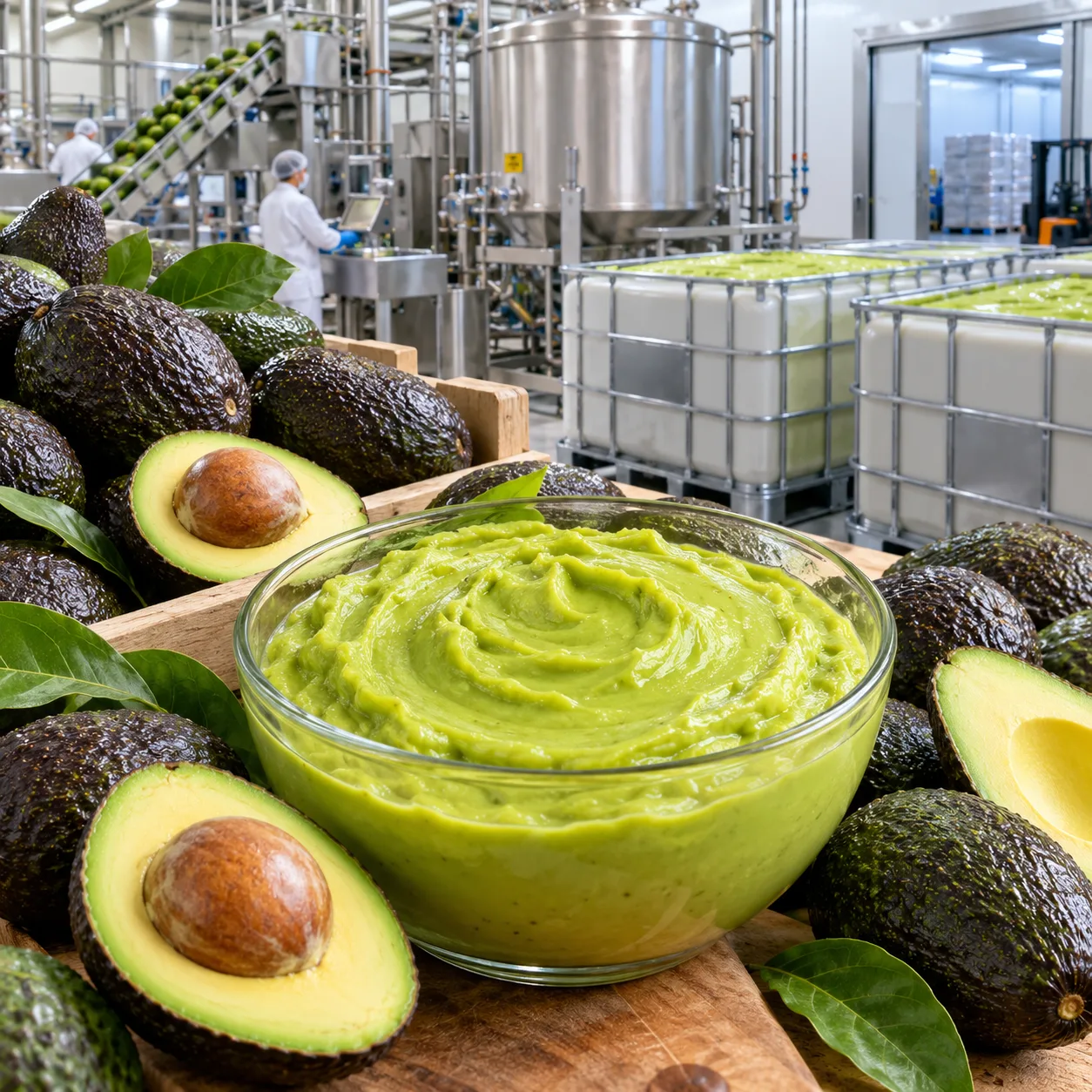
Ripeness, oxygen exposure and temperature determine quality.
Hass Avocado Characteristics
Ripe Hass avocado develops creamy green-to-yellow flesh with a buttery texture and mild nutty flavor. Dry matter and oil content increase as the fruit matures, directly affecting richness and consistency.
Under-mature fruit can produce thinner flavor and less creamy texture, while properly matured fruit provides the fuller mouthfeel expected in premium avocado products.
Oxidation & Browning
Once avocado flesh is exposed to air it can brown rapidly. Commercial processing therefore emphasizes oxygen control, rapid chilling, vacuum or barrier packaging and tightly controlled storage.
Some formulations use lime or lemon juice, citric acid, ascorbic acid or other permitted ingredients to support color and pH stability. Buyers should specify whether additives are acceptable.
Green color is a key commercial quality parameter. Evaluate the puree after the intended thawing, mixing and shelf-life conditions rather than judging only a freshly opened sample.
Avocado requires a different specification approach than most fruit purees.
Exact parameters depend on variety, maturity, processing method and whether the product is 100% avocado or acidified/seasoned. The current supplier specification and lot Certificate of Analysis should always govern approval.
Physical & Chemical Parameters
- Avocado variety, commonly Hass
- Total solids or dry matter where required
- Oil or fat content
- pH and acidity
- Consistency or viscosity
- Particle size / screen specification
- Green color and browning tolerance
- Peroxide value where fat oxidation is critical
Microbiological Requirements
Commercial specifications typically include maximum limits for aerobic plate count, yeast, mold, coliforms and other indicators, together with negative requirements for relevant pathogens.
HPP, frozen and thermally processed products can have different microbiological specifications and shelf-life expectations, so the process type should be clearly identified when comparing offers.
Brix is not the primary quality measure for avocado puree. Fat, solids, ripeness, consistency, color stability and oxidation control are usually more meaningful commercial parameters.
Select the preservation system around flavor, shelf life and distribution.
Frozen Avocado Puree
Frozen puree or pulp is widely used in industrial and foodservice supply chains. Freezing limits oxidation and preserves avocado character when cold-chain handling is properly maintained.
Commercial frozen Hass pulp programs may provide up to approximately 24 months unopened shelf life at -18°C or below.
HPP / Chilled Pulp
High Pressure Processing is commonly used for refrigerated avocado pulp and guacamole because it can improve microbiological stability while avoiding the flavor and color changes associated with stronger thermal treatments.
Commercial chilled shelf life varies by product, formulation and packaging and must be confirmed with the processor.
Aseptic / Acidified Programs
Selected processors may offer aseptic or acidified avocado puree. Because natural avocado is a low-acid food, shelf-stable thermal processing requires a properly validated commercial process.
Do not assume an avocado product is ambient-stable solely because it is packed in a sterile bag or drum.
Where avocado puree is used commercially.
Guacamole & Dips
Guacamole is one of the primary industrial uses for avocado pulp. Smooth or chunky puree can be blended with lime, onion, tomato, herbs, chili, salt and other ingredients to produce foodservice, refrigerated or frozen guacamole.
Spreads & Sandwich Applications
Avocado puree provides a creamy base for sandwich spreads, wraps, toast toppings, burger applications and prepared sandwich components.
Its naturally high fat content provides richness without requiring the same emulsifier system as many conventional spreads.
Sauces & Dressings
Puree can provide body and fat in green sauces, avocado dressings, creamy dips, condiment sauces and plant-based dressing systems.
Acid level, emulsification and oxidation stability should be validated in the complete finished formulation.
Prepared Foods & Ready Meals
Applications include burritos, bowls, tacos, frozen meals, prepared salads and other convenience foods where avocado flavor and creamy texture are required.
Process timing and temperature are especially important where avocado is exposed to reheating or extended holding.
Plant-Based Foods
Avocado puree can contribute natural fat, richness and smooth texture to plant-based spreads, sauces, savory fillings and dairy-style formulations.
It is especially useful in products seeking recognizable whole-food ingredients rather than highly refined oils alone.
Foodservice & QSR
Frozen or HPP avocado pulp allows restaurants, caterers and central kitchens to reduce ripening, peeling and preparation labor while improving portion consistency and reducing fresh-fruit waste.
Baby Food & Specialty Nutrition
Smooth avocado puree can be used in selected infant foods, vegetable blends and nutrition products where creamy texture and avocado solids are desirable.
These applications may require tighter residue, microbiological and ingredient controls.
Smoothies & Specialty Beverages
Avocado is used in selected smoothies, shakes and nutrition beverages where its primary role is to provide body, richness and a creamy mouthfeel rather than sweetness.
Homogenization and suspension should be evaluated because avocado contains significant insoluble solids and fat.
Packaging should match storage lane and production volume.
Foodservice Pouches
Frozen and HPP avocado pulp is commonly available in portioned or multi-pound pouches and bags for foodservice and central-kitchen use. Commercial formats range from small packs to large case-packed bags.
Bulk Pails & Cases
Pails, lined cartons and larger frozen blocks can support medium-volume food manufacturing programs. Pack format should be selected according to normal batch consumption after opening.
Industrial Bulk
Larger commercial programs may use industrial pouches, drums or other bulk systems depending on processor capability. Confirm cold-chain requirements, thawing procedure, net weight and pallet configuration before contracting supply.
Define process, fat level and color requirements before comparing offers.
Technical Requirements
- Avocado variety and maturity specification
- Oil / fat or total-solids requirement
- Natural or acidified formulation
- pH and permitted ingredients
- Smooth or chunky texture requirement
- Particle size or screen specification
- Color and oxidation tolerance
- Microbiological limits and shelf-life target
Commercial Requirements
- Conventional or certified organic status
- Frozen, chilled/HPP or aseptic preference
- Trial quantity and expected annual demand
- Pouch, case, pail, drum or bulk preference
- Country-of-origin requirements
- Delivery destination in the United States
- Cold-storage and receiving capability
- Certification and documentation requirements
Avocado pricing and availability are influenced by crop timing, origin, fruit size and raw-material market conditions. Recurring manufacturing programs should communicate volume forecasts and approved specification ranges early in the sourcing process.
Documents commonly reviewed during supplier approval.
Technical Documentation
- Current product specification
- Lot-specific Certificate of Analysis
- Microbiological specification
- Ingredient and additive declaration
- Fat / oil or solids specification where required
- Storage and shelf-life information
- Packaging and thawing instructions
Certification & Supply Documents
- Organic certificate when applicable
- Food-safety certification information
- Kosher or other requested certification
- GMO status where required
- Country-of-origin information
- Traceability and lot identification
- Commercial quotation and delivery terms
See how ingredient format affects formulation.
Avocado puree sourcing questions
What is commercial avocado puree?
Commercial avocado puree or pulp is produced from ripe avocado flesh after the skin and pit are removed. Hass is widely used because of its creamy texture, relatively high oil content and characteristic flavor.
What specifications are most important?
Buyers commonly review avocado variety, fat or oil content, total solids, pH, consistency, particle size, green color, oxidation tolerance, microbiological limits, permitted ingredients and processing method.
What is the typical pH?
Natural avocado pulp is a relatively low-acid food. Published commercial 100% Hass pulp specifications can be around pH 6 or higher. Acidified products may have substantially lower pH depending on the formulation. Always use the current supplier specification.
What is bulk avocado puree used for?
Major applications include guacamole, dips, sandwich spreads, sauces, dressings, prepared meals, plant-based foods, foodservice preparations, baby food and selected smoothies or nutrition products.
Why is oxidation control important?
Avocado flesh browns quickly when exposed to oxygen. Processing, packaging, storage temperature and permitted acid or antioxidant systems are therefore important for maintaining acceptable green color.
Is organic avocado puree available?
Certified organic avocado puree may be available depending on crop, origin and processor. Request current certification covering the exact product being quoted.
How is commercial avocado puree supplied?
Common commercial formats include frozen or chilled/HPP pouches, bags, cases, pails and industrial bulk packs. Selected processors may also offer acidified or aseptically processed products.
What information should I provide for a quote?
Provide the required avocado variety, smooth or chunky format, conventional or organic grade, approximate volume, processing format, preferred packaging and destination, together with requirements for fat, solids, pH, additives, color, microbiology and shelf life.