Kale Juice Concentrate
Bulk kale juice concentrate for green beverages, smoothies, vegetable blends, soups, sauces, dressings, plant-based foods and other commercial applications, with conventional and organic programs subject to current availability.
Concentrated leafy-green character for vegetable-based formulations.
Kale is a leafy member of Brassica oleracea, commonly grouped with non-heading cabbages. Commercial types include curly green kale, Lacinato or dinosaur kale, red or purple kale and other regional cultivars selected for leaf yield, color, texture and flavor.
Fresh kale has an earthy, grassy and distinctly cruciferous flavor that can range from mildly sweet to noticeably bitter depending on variety, maturity and growing conditions. Its intense green appearance comes primarily from naturally occurring chlorophyll pigments.
Kale juice concentrate is typically produced from washed leaves that are crushed or pressed to obtain vegetable juice, followed by screening or filtration and controlled water removal. Commercial grades are generally cloudy rather than highly clarified and may be supplied either as 100% kale or as an acidified formulation.
- Commercial programs are available at different concentration levels rather than one standard Brix
- Current market examples include approximately 20° and 40° Brix grades
- Cloudy green concentrate is the most typical commercial profile
- Some grades contain only kale while others are acidified for process or color objectives
- Conventional and certified organic products are commercially available
- Frozen drums, jerrycans, pails and other industrial packs may be offered
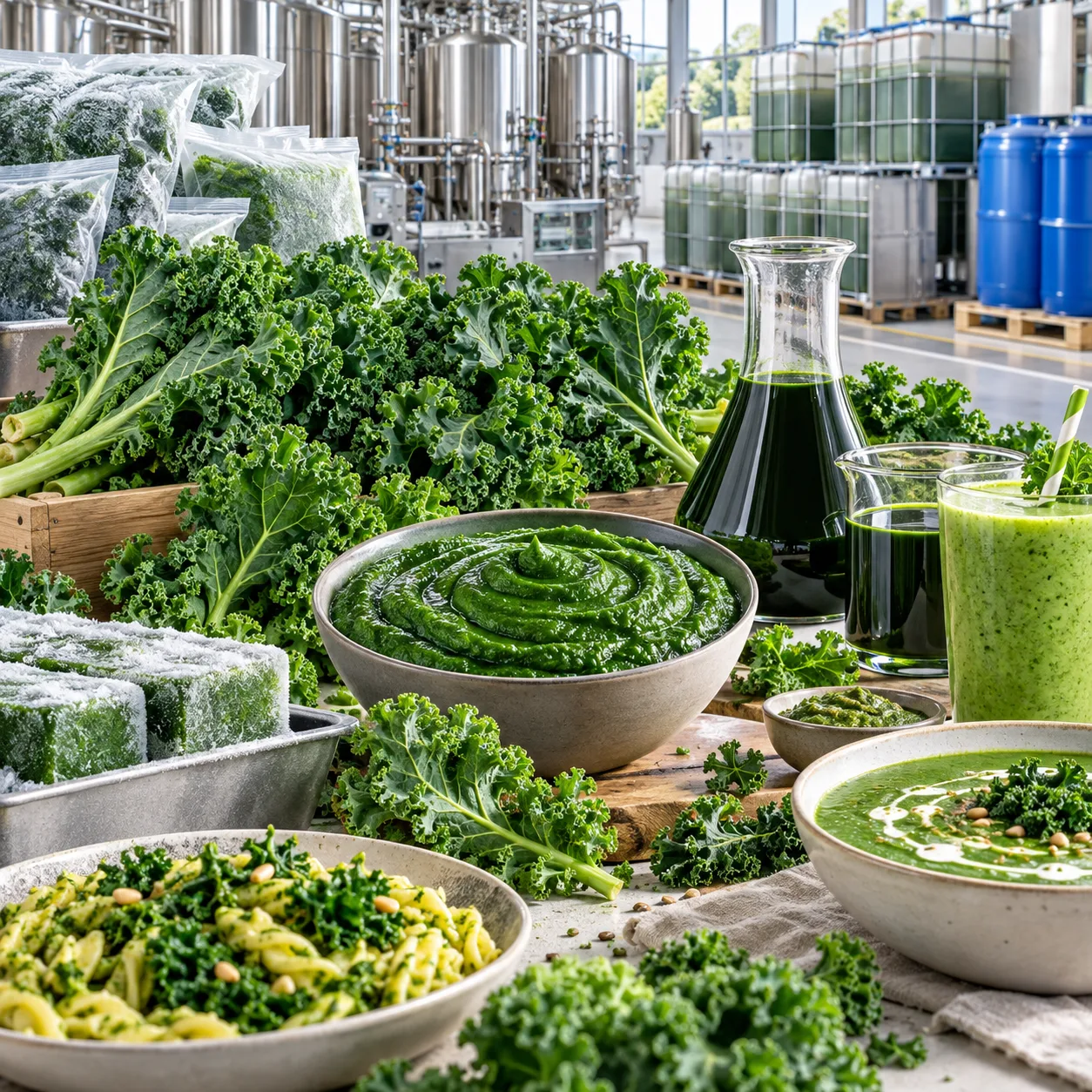
Kale concentrate is less standardized than fruit concentrate.
20° Brix Concentrate
Certified-organic 20° Brix kale concentrate is present in current commercial programs. Lower-Brix concentrate can provide relatively easy pumping and reconstitution while still reducing the amount of water shipped compared with single-strength juice.
30–40° Brix Concentrate
More concentrated programs are also available. Commercial examples include approximately 30° Brix and cloudy 40° Brix kale concentrate. Higher solids increase storage efficiency but can also increase viscosity and intensify the leafy flavor.
Acidified Kale Concentrate
Some commercial grades are intentionally acidified, including products formulated with lemon juice. Acidification changes pH, flavor and color behavior, so it should always be identified in the ingredient statement and technical specification.
Kale NFC & Puree
NFC kale juice and kale puree are separate formats. NFC provides single-strength juice character, while puree retains more leaf solids and body. These formats should not be compared directly with juice concentrate on Brix alone.
Format note: Specify whether the requirement is for 100% kale concentrate, an acidified kale concentrate, NFC juice or puree. The ingredients can differ substantially in pH, Brix, color, viscosity and processing behavior.
Specification points that matter for commercial qualification.
Kale concentrate should be purchased against the actual supplier specification rather than a generic category standard. Soluble solids, pH, acidification, color and suspended solids can differ significantly between processors.
Soluble Solids / °Brix
Unlike apple or grape concentrate, kale does not have one dominant concentration standard. Current market programs include 20° Brix organic concentrate and 40° Brix cloudy concentrate, with other concentrations available from different processors.
pH & Acidity
Confirm whether the concentrate is naturally processed or acidified. Kale juice itself is a relatively low-acid vegetable ingredient, while acidified commercial grades can have very different pH and titratable-acidity values.
Color
Commercial kale concentrate should have a characteristic green vegetable appearance appropriate to the agreed process. Color can range from bright or dark green toward olive-green depending on heat exposure, pH, raw material and storage.
Flavor & Aroma
Expect characteristic kale notes: leafy, grassy, vegetal and cruciferous, sometimes with mild bitterness. The material should be free from fermented, scorched, stale or otherwise objectionable flavor.
Cloud & Insoluble Solids
Kale concentrate is commonly cloudy and contains suspended vegetable material. Where sediment, pumpability or beverage appearance is critical, request limits for insoluble solids, screen size, turbidity or settling behavior.
Viscosity & Flow
Higher-Brix cloudy concentrate can become noticeably more viscous, particularly when frozen or cold. Receiving, thawing, pumping and metering equipment should be assessed for the specific product.
Microbiological Criteria
Commercial specifications should define applicable limits for total aerobic count, yeast, mold, coliforms and relevant pathogens. Criteria depend on process, package, storage and whether the product is pasteurized or aseptically packed.
Ingredient Composition
Confirm whether the material is 100% kale juice concentrate or contains lemon juice, another acidifying juice or other ingredients. This affects labeling, pH, sensory performance and comparison between offers.
Specification note: Kale concentrate is not sufficiently standardized for one universal Brix, pH or acidity range. Use these commercial examples only for sourcing orientation and purchase against the supplier's current TDS/specification and lot-specific COA.
Where kale juice concentrate is used.
Green Juices & Vegetable Beverages
Kale concentrate is used in green juices and vegetable beverage blends where manufacturers need repeatable leafy flavor and green vegetable solids without processing fresh kale at the beverage plant.
Smoothies
Kale works well in smoothies blended with apple, pineapple, mango, banana, pear, cucumber, celery, lemon or ginger. Sweeter fruit components can balance its grassy and mildly bitter notes.
Nutrition & Functional-Style Beverages
Concentrate can be incorporated into green beverage shots, vegetable blends and nutrition beverages where concentrated vegetable content and a recognizable leafy profile are desired.
Soups & Broths
Kale concentrate can contribute leafy vegetable character to green soups, vegetable broths, blended soups and concentrated culinary bases without introducing large pieces of leaf material.
Sauces, Dressings & Dips
Applications include vegetable sauces, pesto-style systems, green dressings, dips and savory spreads. Garlic, herbs, lemon, vinegar and olive-oil flavors pair naturally with kale.
Plant-Based Foods
Kale concentrate can be used in plant-based soups, vegetable protein preparations, fillings and ready meals where vegetable flavor and green appearance support the intended product profile.
Vegetable Preparations
Prepared vegetable bases and blended greens can use concentrate to standardize color and flavor across seasons and reduce the storage and handling requirements associated with fresh kale.
Bakery & Savory Snacks
Kale concentrate can be incorporated into breads, crackers, wraps, savory dough systems and vegetable snack formulations where green vegetable identity is desired. Heat-related color change should be expected.
Baby & Toddler Foods
Qualified kale ingredients may be used in vegetable and fruit-vegetable blends intended for younger consumers. These projects require application-specific contaminant, pesticide, microbiological and documentation controls beyond ordinary commercial food requirements.
Fermented Vegetable Beverages
Kale can be incorporated into selected fermented vegetable beverages and kombucha-style blends. Fermentation performance should be validated because concentrate composition, pH and acidification vary between commercial grades.
Green color is one of the main processing challenges.
Manage Heat Exposure
Kale's green chlorophyll pigments are heat-sensitive. Longer or more severe thermal treatment can move the color away from bright green toward dull or olive tones, so the finished process should be evaluated for both safety and color retention.
Consider the Effect of pH
Acidification can improve process options for vegetable beverages but can also accelerate the conversion of bright-green chlorophyll pigments toward olive-green forms during heating. Acidified and non-acidified products should therefore be evaluated separately.
Balance Leafy Flavor
Kale can become dominant at high dosage. Apple, pear, pineapple, mango, cucumber, lemon, ginger and other ingredients are commonly useful for balancing grassy, brassica and bitter notes in beverage formulations.
Manage Sedimentation
Cloudy vegetable concentrate can separate during storage or in the finished drink. Homogenization, particle-size control and stabilizer strategy may be important where a uniform beverage appearance is required.
Do not assume that a concentrate's incoming dark-green color will remain unchanged after dilution, acidification, pasteurization and shelf-life storage. Color and flavor should be approved in the complete finished-product process.
Define the product before comparing prices.
Kale concentrate offers can differ more than many high-volume fruit concentrates. Brix, acidification, cloudy solids, origin and storage format should all be established before commercial quotations are compared.
Information to include in a sourcing request
- Kale juice concentrate, NFC juice or puree
- Target Brix or existing supplier specification
- 100% kale or permitted acidified formulation
- Required pH or titratable acidity if relevant
- Cloud, insoluble-solids or particle-size requirements
- Green color and sensory expectations
- Conventional or certified organic status
- Preferred origin if required
- Sample or pilot-production quantity
- Commercial order size and estimated annual volume
- Frozen, refrigerated or aseptic capability
- Preferred packaging format
- Required food-safety and quality documentation
- Delivery destination and requested timing
Commercial note: Compare offers on cost-in-use rather than price per pound alone. A 20° Brix concentrate and a 40° Brix concentrate deliver different amounts of vegetable solids and can require very different inclusion rates.
Cold-chain formats are common for color-sensitive kale ingredients.
Frozen Drums
Frozen drums are a common commercial format. One current European organic program supplies kale concentrate in approximately 240 kg frozen drums, while exact fill weight varies by supplier and concentration.
Jerrycans & Smaller Packs
Representative commercial programs also include approximately 20 kg frozen jerrycans, while other suppliers may offer pails or similar formats for development and smaller manufacturing runs.
Frozen Storage
Current cloudy 40° Brix commercial concentrate is offered frozen at approximately -18°C. Frozen handling can help limit quality changes in green vegetable ingredients during storage.
Aseptic Options
Aseptic or other processed formats may be available depending on processor and concentration. Confirm whether ambient, refrigerated or frozen storage is required for the exact item rather than assuming packaging alone determines storage conditions.
Review composition, color and food-safety data together.
Certificate of Analysis
The lot-specific COA should be reviewed against contracted requirements for Brix, pH where specified, microbiological criteria and any other agreed physical or chemical parameters.
Ingredient Declaration
Confirm whether the product contains only kale or is acidified with lemon juice or another permitted ingredient. This distinction should be clear before formula and label approval.
Contaminant & Agricultural Controls
Where required by the finished-product category, request appropriate pesticide, heavy-metal, nitrate or other agricultural contaminant documentation based on the customer's risk assessment and specification.
Organic & Other Certifications
For organic projects, obtain current certification covering the exact concentrate and processing facility. Kosher, GMO-status, allergen, origin, traceability and recognized food-safety documentation may also be requested.
See how ingredient format affects formulation.
Puddings & Desserts
Puddings & Desserts with Juice Concentrates: Sourcing & Process Considerations
Juice ConcentratesFruit Leather
Using Juice Concentrates in Fruit Leather: Formulation Guide
Juice ConcentratesCocktail Mixes
Cocktail Mixes with Juice Concentrates: Sourcing & Process Considerations
Questions kale concentrate buyers often ask
What is kale juice concentrate?
Kale juice concentrate is produced from washed kale leaves by extracting vegetable juice and removing part of its water. It is generally a cloudy green ingredient used in vegetable beverages and savory formulations.
What Brix is commercial kale juice concentrate?
Kale concentrate does not have one universal commercial Brix. Current programs include approximately 20° Brix organic concentrate and 40° Brix cloudy concentrate, while 30° Brix products have also been produced. Confirm the actual supplier specification.
Is kale concentrate always 100% kale?
No. Some products are made from 100% kale, while other commercial grades are deliberately acidified, for example with lemon juice. Confirm the complete ingredient declaration before comparing products.
Why can kale concentrate turn olive-green?
Kale contains chlorophyll pigments that are sensitive to heat and pH. Thermal treatment, particularly in acidic systems, can shift the color from brighter green toward more olive-green tones.
What is bulk kale juice concentrate used for?
Major applications include green juices, vegetable beverage blends, smoothies, nutrition beverages, soups, sauces, dressings, dips, plant-based foods, vegetable preparations, ready meals and selected savory bakery products.
How does concentrate differ from kale puree?
Juice concentrate is produced primarily from extracted vegetable juice and generally has less coarse leaf material. Puree retains more of the physical leaf tissue and provides greater body and suspended solids.
Is organic kale juice concentrate available?
Yes. Certified organic kale concentrate is commercially available, including current 20° Brix programs. Organic NFC kale juice and puree formats are also available from some suppliers.
What pack sizes are available?
Commercial programs may include pails, approximately 20 kg jerrycans, frozen drums around 240 kg and other bulk systems. Availability and minimum order quantity depend on the supplier and product.
What should I include in a quote request?
Provide the desired format and Brix, whether acidification is acceptable, color and sensory requirements, quantity, annual volume, organic or conventional status, packaging, storage capability, destination, certifications and requested delivery timing.